
The Ontario Not-for-Profit Corporations Act (“ONCA”) came into force on October 19, 2021 and groups have until October 19, 2024 to bring themselves into compliance with the ‘new’ act. Many groups who have not begun the process yet will probably not be able to meet that deadline.
The Ontario non-profits that typically require the most time are:
- Registered charities that should get preapproval for object changes. Such pre-approval from CRA requires both objects and a detailed statement of activities. Some charities can take months to prepare the submission and then CRA in the past took 2 months to review but they are now backlogged with ONCA requests and it is taking 6-8 months. Even if a registered charity is not changing its objects, CRA may not accept old objects and the group may have to change them. With some groups, this could be embarrassing or time-consuming.
- Ontario non-profits with large memberships. While calling a members’ meeting is quite easy for some groups, for others with large memberships and/or groups needing to come together in person, the time and cost of having a separate meeting aside from the normal AGM can be quite significant. For some groups it would have been much better to combine the ONCA changes with their AGM but they may be out of time and need a special meeting.
- Groups that require external approval for governance changes. Many groups are not completely independent and they may be a branch or affiliate of another organization. In some cases, the umbrella organization may not even be in Canada and they may take time to try to understand the corporate changes and to internally approve them.
- Groups that wish to make significant changes to their current structure. Some charities are making more ‘technical’ compliance changes that may or may not be too difficult or potentially controversial, but others want to make significant changes. If, for example, a group has a large membership and the costs of such membership far outweigh the benefits, then a group may wish to change such membership. These are not simple and easy discussions. If one wants to go from a large open membership to a small closed membership, there may need to be a lot of discussion and communication required in order to carry out such a major change.
With so many changes between the old OCA and the new ONCA it is important that the governing documents of the non-profit or charity is updated. Except for dormant corporations it can be very problematic to ignore the ONCA changes or not revise older documents.
Some of the many problems with not making changes:
- default provisions of ONCA will be deemed to apply to your organization, and that may be very problematic for some, and it may not be obvious (e.g., if you don’t have a quorum provision for members meetings, then quorum for members meetings is a majority of members entitled to vote at the meeting and for larger memberships this may be difficult or impossible)
- normal changes, such as to objects, membership, etc., may be needed and long overdue. Are your objects adequate for your needs? If so, fine, but CRA may not accept them as we have discussed in other articles.
- it may be very difficult for staff and board to understand and interpret documents if what you are reading is not actually what is required because ONCA overrides your corporate documents
Without a thorough analysis it is not possible to know how the ONCA changes will affect a particular organization and having ONCA compliant documents is the best approach from a governance and cost point of view.
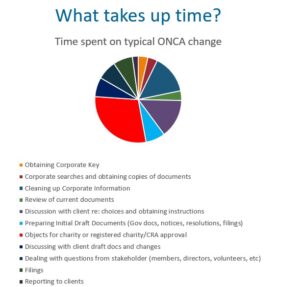
There is a common misconception that preparing the new documents is most of the work. It is often only 10-20% of the time required. There are so many other matters that need to be dealt with like obtaining corporate keys, doing corporate searches and updating directors/officers/addresses, etc. We created a little graphic to illustrate the point.
If your non-profit or registered charity requires assistance with ONCA, you can retain our law firm to review your documents and discuss options with you.